Piano works by Bacewicz, Chopin and Liszt

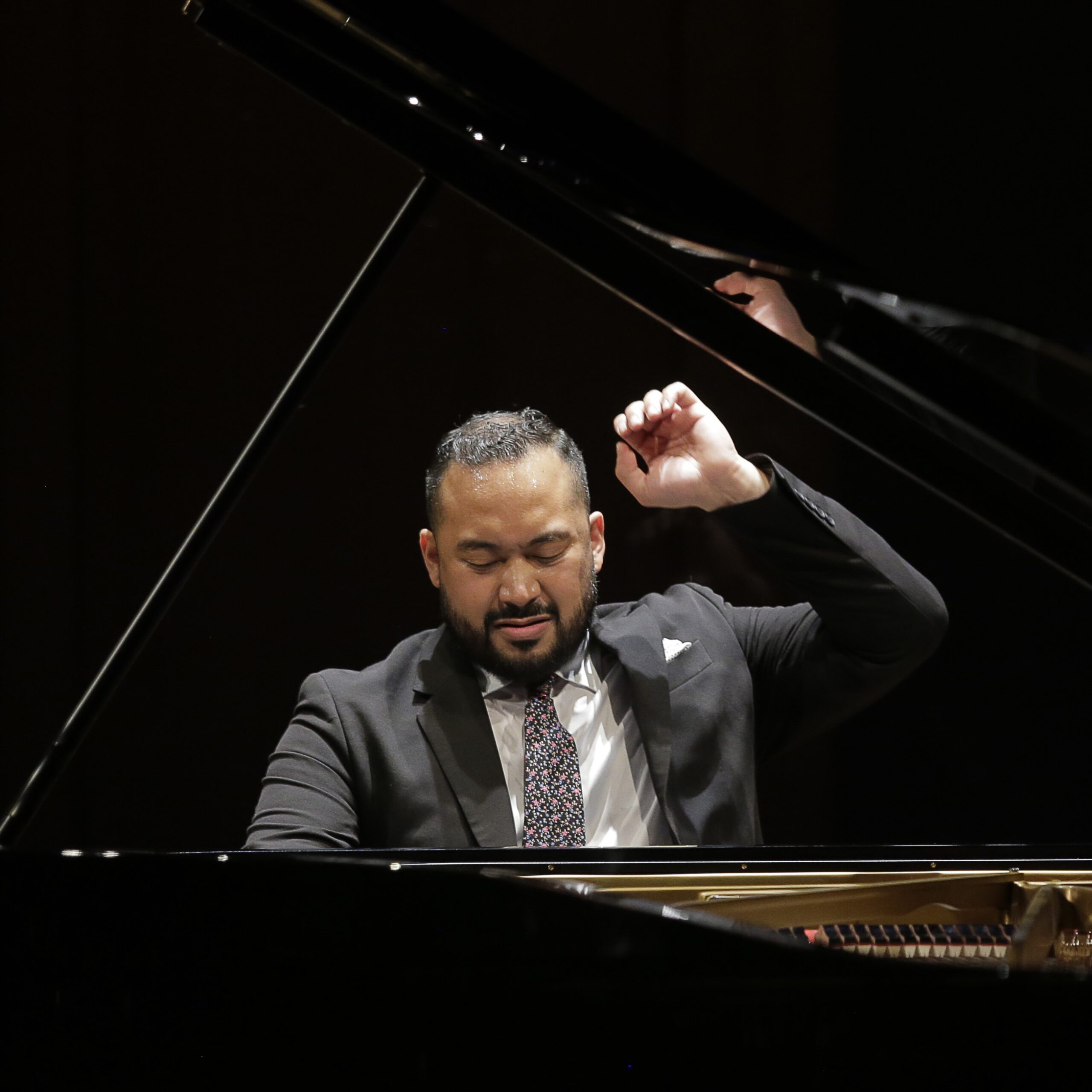
Mateusz Mikolajczak, piano

  • Grażyna Bacewicz (1909–1969) – Piano Sonata No. 2 (1953) (18’)
  • I. Allegro
  • II. Largo
  • III. Vivo
  • Frédéric Chopin (1810–1849) – Polonaise-Fantaisie, Op. 61 (1846) (13’)
  • Franz Liszt (1811–1886) – Années de pèlerinage, Deuxième année: Italie – "Sonetto 104 del Petrarca", S.161 No. 5 (1846/1858) (7’)
  • Grażyna Bacewicz (1909–1969) – Piano Sonata No. 2 (1953) (18’)
  • Grażyna Bacewicz's Piano Sonata No. 2 stands among the most significant works in the twentieth-century Polish piano literature. Written after World War II, the sonata reflects the composer's distinctive musical language, balancing neoclassical clarity with rhythmic vitality, expressive lyricism, and modern harmonic color. A celebrated violinist as well as composer, Bacewicz brought a remarkable understanding of instrumental virtuosity to her keyboard writing. The opening Allegro is driven by sharply defined motives and striking emotional contrasts, balancing restless energy and anxiety with moments of unexpected lyricism and sentimentality. The central Largo opens an introspective, almost hypnotic sound world, unfolding with the stillness of meditation and the bittersweet quality of memories that seem forever out of reach. The concluding Vivo bursts forth with dazzling brilliance while drawing unmistakably on Polish folk tradition: its principal theme is based on the oberek, a polish national dance, whose whirling rhythms and infectious vitality propel the movement toward an exhilarating conclusion. Throughout the sonata, Bacewicz fuses emotional intensity with architectural precision, creating a work that is both intellectually compelling and deeply expressive.
  • Frédéric Chopin (1810–1849) – Polonaise-Fantaisie, Op. 61 (1846) (13’)
  • Composed in 1846, Frédéric Chopin's Polonaise-Fantaisie, Op. 61, is one of the composer's most original and enigmatic masterpieces. Written during the final years of his life, it transcends the traditional character of the polonaise, blending its noble rhythmic identity with the freedom and unpredictability of the fantasy. Rather than following a conventional formal design, the work unfolds organically through a series of evolving musical ideas, anticipating aspects of later musical thought through its harmonic daring and unprecedented formal freedom. The piece moves seamlessly between moments of heroic grandeur, intimate reflection, and poetic reverie. Often regarded as one of Chopin's most spiritual compositions, the Polonaise-Fantaisie possesses an almost improvisatory quality while maintaining remarkable architectural unity. Long admired for its sophistication and emotional complexity, the work invites listeners into an intensely private musical narrative that resists easy interpretation while pointing toward musical ideas that would not fully blossom until decades later.
  • Franz Liszt (1811–1886) – Années de pèlerinage, Deuxième année: Italie – "Sonetto 104 del Petrarca", S.161 No. 5 (1846/1858) (7’)
  • Franz Liszt's Sonetto 104 del Petrarca from the Années de pèlerinage: Deuxième année – Italie was inspired by Petrarch's sonnets dedicated to Laura, the poet's idealized beloved. Originally conceived as a song before being transformed into a piano work, the piece preserves the expressive qualities of the human voice while expanding them through Liszt's richly imaginative pianistic writing. Filled with passion, longing, and sweeping emotional intensity, the music moves effortlessly between moments of ecstatic outpouring and profound intimacy. Its soaring melodic lines seem to search constantly for something just beyond reach, while passages of remarkable tenderness evoke the lingering presence of a love that has vanished, yet continues to resonate in memory and in the heart. Rather than dazzling through outward virtuosity alone, Liszt employs the piano as a vehicle for lyrical expression, subtle color, and emotional transcendence. The result is one of his most poetic creations, where technical brilliance becomes inseparable from profound emotional expression.

Mateusz Mikolajczak began music studies at the age of six with Joanna Samelczak. A native of Poland, Mateusz has been awarded top prizes in international competitions, including the Mieczysław Munz Juilliard Piano Competition, Franz Liszt International Piano Competition, Busan Maru International Music Festival Competition, and the Karol Lipiński International Piano Competition. He has performed at the National Forum of Music in Wrocław, the National Philharmonic Hall in Warsaw, and the Chopin Manor in Duszniki-Zdrój. He has performed extensively across Europe, the United States, and Asia. In November 2024, he made his debut at Carnegie Hall, followed by his Lincoln Center debut at Alice Tully Hall in February 2025. He has received scholarships from the Polish Ministry of Culture and Heritage, Santander Bank Polska, the Albeniz Foundation, and the Rafał Brzoska Foundation.

He has refined his artistry through masterclasses with pianists such as Lilya Zilberstein, Pierre-Laurent Aimard, Nikolai Demidenko, Robert Levin, Rena Shereshevskaya, Mikhail Voskresensky, and Dmitri Bashkirov, and has appeared at international festivals including PianoFest in the Hamptons, the Duszniki International Chopin Piano Festival, and Piano City Madrid.

He graduated with a Bachelor’s degree in Piano Performance from the Karol Lipiński Academy of Music in Wrocław, studying under Professors Grzegorz Kurzynski and Helena Furmanowicz-Kurzyńska. He later pursued advanced training at the Reina Sofía School of Music in Madrid with Milana Chernyavska, Claudio Martínez Mehner, Denis Lossev, and Marta Gulyás (chamber music). In May 2025, he completed his Master’s degree at The Juilliard School and will continue this fall in the highly selective Artist Diploma program, where he will continue working with Soyeon Kate Lee.

About the Dame Myra Hess Concerts

The concerts are generously sponsored by the Paul M. Angell Family Foundation, the Illinois Arts Council and by individual donors.

Upcoming Performances

Stay connected with us on social
Join our mailing list and stay up to date.
<

Subscribe

* indicates required