
Pianists Fan Favorites
Seventeenth Church of Christ, Scientist, Chicago, 55 E. Wacker Drive

November 11, 2026

12:15 PM

Seventeenth Church of Christ, Scientist, Chicago - 55 E. Wacker Drive
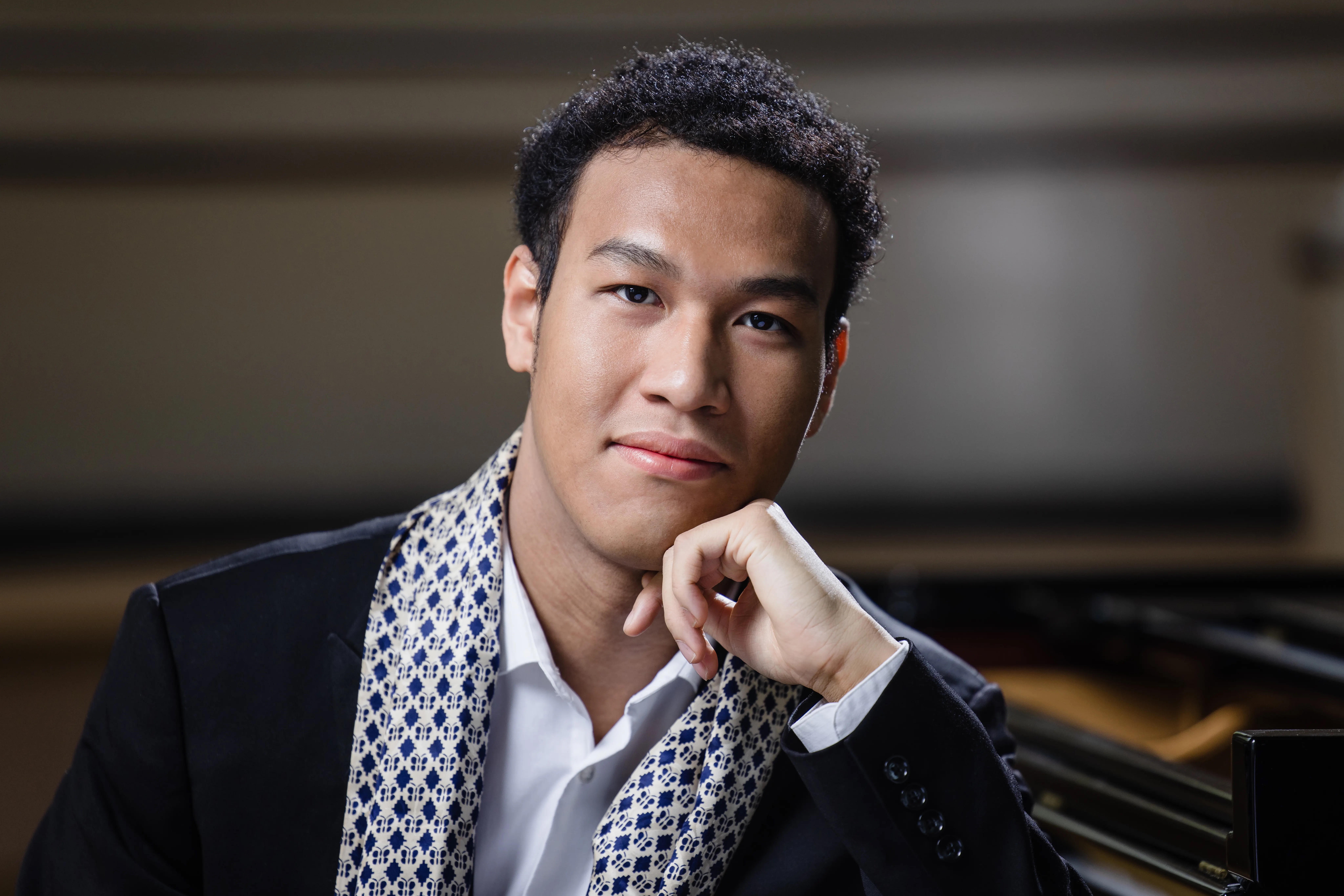
American pianist Clayton Stephenson’s love for music is immediately apparent in his joyous charisma onstage, expressive power, and natural ease at the instrument. Hailed for “extraordinary narrative and poetic gifts” and interpretations that are “fresh, incisive and characterfully alive” (Gramophone), he is committed to making an impact on the world through his music-making.
Growing up in New York City, Clayton started piano lessons at age 7, and the next year was accepted into The Julliard School’s Music Advancement Program—a full scholarship program for disadvantaged students—where he lingered to watch student recitals and fell in love with music. Clayton practiced on a synthesizer at home until he found an old upright piano on the street. For the next six years that would be his practice piano, until, at the age of 17, he received a new piano from the Lang Lang Foundation.
He credits the generous support of community programs with providing him musical inspiration and resources along the way. As he describes it, the “Third Street Music School jump-started my music education; the Young People’s Choir taught me phrasing and voicing; Juilliard’s Music Advancement Program introduced me to formal and rigorous piano training, which enabled me to get into Juilliard Pre-College; the Morningside Music Bridge validated my talent and elevated my self-confidence; the Boy’s Club of New York exposed me to jazz; and the Lang Lang Foundation brought me to stages worldwide and transformed me from a piano student to a young artist.”
Highlights of his 2025-26 season include a performance of the Brahms Concerto # 2 with the Cincinnati Orchestra, performances of Gershwin’s Concerto in F with the Philadelphia Orchestra at the Saratoga Arts Festival, Festival Internazionale Palermo (Italy), Boston Pops and Sarasota Orchestra. He will play the Ravel Concerto in G with the Nashville and Portland (Maine) Symphonies as well as the Stuttgart Philharmonic (Germany). In addition he gives recitals at the Jacobins Festival (Toulouse, France), Concertgebouw (Amsterdam), Isabella Gardner Museum (Boston) and Crystal Bridges Museum (Arkansas). Clayton finishes his season in spring 2026 on tour with the Stuttgart Philharmonic in Italy.
Recent seasons have included concerto performances with the Houston, North Carolina, Virginia and Cincinnati Symphonies; festival appearances at Grand Teton, Grant Park, and Tippet Rise; recitals at the Kennedy Center for Washington Performing Arts and the 92nd Street Y in New York City; and gala performances with the New York and Las Vegas Philharmonics. He also served as the 2024-25 Artist-in-Residence at the Hartford Symphony.
Clayton Stephenson graduated from the Harvard-New England Conservatory (NEC) dual degree program in spring 2023 with a BA in economics from Harvard and a Masters degree in piano performance from NEC under Wha Kyung Byun. In addition to being the first Black finalist at the Van Cliburn International Piano Competition in 2022, he has been a recipient of a 2024 Avery Fisher Career Grant, won the inaugural Nina Simone Piano Competition in 2024 and received a Sphinx Medal of Excellence in 2025.
Clayton Stephenson appears by arrangement with the Cliburn Agency.
The concerts are generously sponsored by the Paul M. Angell Family Foundation, the Illinois Arts Council and by individual donors.
Program: Dame Myra Hess Memorial Concerts
Seventeenth Church of Christ, Scientist, Chicago, 55 E. Wacker Drive
Program: Dame Myra Hess Memorial Concerts
Seventeenth Church of Christ, Scientist, Chicago, 55 E. Wacker Drive
Program: Dame Myra Hess Memorial Concerts
Seventeenth Church of Christ, Scientist, Chicago, 55 E. Wacker Drive