
Distinguished Hess Alumni: Clayton Stephenson, piano
Seventeenth Church of Christ, Scientist, Chicago, 55 E. Wacker Drive


December 09, 2026

12:15 PM

Seventeenth Church of Christ, Scientist, Chicago - 55 E. Wacker Drive
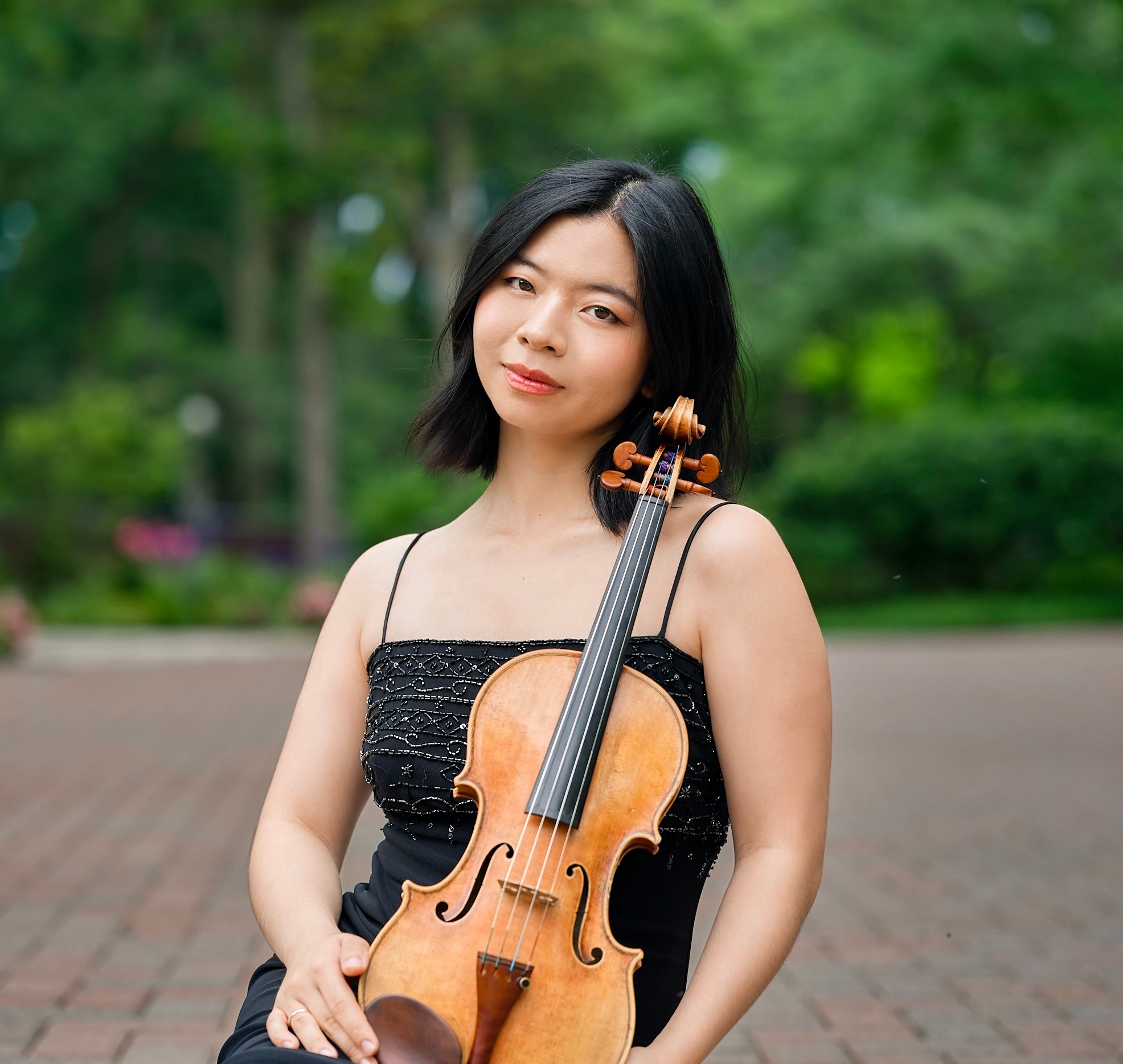
Recognized for her “rare capacity to project a totally distinctive and fascinating intellect” (Spokesman Review) and easy virtuosity…humor, nuance … [and] playful[ness]” (Cleveland Classical), American violinist Karisa Chiu first came to international prominence with her first prize win at the 2021 Isangyun Violin Competition, resulting in her debut with the KBS Symphony Orchestra at the Seoul Arts Center. She has since appeared on major stages worldwide, including Weill Hall at Carnegie Hall, Severance Hall, Alice Tully Hall, and the Casals Forum. A top prize winner of the Singapore, Menuhin, Leopold Mozart, and Irving M. Klein Competitions, Karisa continues to earn recognition for her artistry. Her debut album, titled Home, in collaboration with pianist Zhu Wang and Cedille Records, released to critical acclaim.
Raised in a musical family, Karisa began her studies at age two with her father, Cornelius Chiu, a first violinist in the Chicago Symphony Orchestra. She collaborates frequently with her mother and uncle, pianists Inah Chiu and Frederic Chiu. The Chiu family has given annual concerts for two decades at the Festival of the Arts at Mohonk Mountain House. Karisa continues her familial musical traditions through the Plymouth Chamber Players, a Michigan-based concert series that she co-directs with her husband, Chicago Symphony Orchestra violist Paolo Dara.
Karisa received an Artist Diploma from the Juilliard School, a Master’s degree from the Cleveland Institute of Music, and a Bachelor’s degree from the Curtis Institute of Music. Her mentors include renowned pedagogues Catherine Cho, Donald Weilerstein, Jaime Laredo, Malcolm Lowe, Ida Kavafian, and Almita Vamos.
Umi Garrett is a highly accomplished solo and chamber pianist, having performed numerous recitals in the United States and internationally. Most recently, she performed Messiaen’s Quartet for the End of Time with principal members of the Chicago Symphony Orchestra including Danny Jin, John Sharp, and Stephen Williamson at the University of Chicago, and performed at Carnegie Hall’s Weill Hall in collaboration with double bassist Nina Bernat. She was also recently featured on Interlochen Public Radio as part of a chamber music residency with Viridian Strings. She has performed regularly through presenters such as the Clark Art Institute, the Dame Myra Hess Series, Bay Chamber Concerts, and the Chopin Foundation of the United States.
Umi was awarded first prize at The Juilliard School’s Concerto Competition, fourth prize at the 2020 National Chopin Piano Competition, and awarded the John Newmark Prize for Best Collaborative Pianist for her performances with finalist Nathan Meltzer at the 2023 Montreal International Violin Competition. During the summers, Umi is a Staff Collaborative Pianist for the Program for Piano and Strings at the Ravinia Steans Music Institute, under the leadership of Artistic Director Midori. Umi has released three solo albums and released her debut chamber album in 2024 of the complete Beethoven Cello Sonatas under PARMA Recordings. Umi has received Bachelor’s and Master’s degrees in Piano Performance at the Juilliard School where she was a recipient of the Kovner Fellowship, and previously served as a Collaborative Piano Fellow at the Yale School of Music. She is currently pursuing an Artist Diploma at The Juilliard School with Hung-Kuan Chen and Shai Wosner. Umi is a Young Steinway Artist.

The concerts are generously sponsored by the Paul M. Angell Family Foundation, the Illinois Arts Council and by individual donors.
Program: Dame Myra Hess Memorial Concerts
Seventeenth Church of Christ, Scientist, Chicago, 55 E. Wacker Drive
Program: Dame Myra Hess Memorial Concerts
Seventeenth Church of Christ, Scientist, Chicago, 55 E. Wacker Drive
Program: Dame Myra Hess Memorial Concerts
Seventeenth Church of Christ, Scientist, Chicago, 55 E. Wacker Drive